Roof moss removal and soft washing in Church Stretton
Steep pitches, old slate and slopes that never see much sun. Moss does well on a Stretton roof, and it comes back for reasons worth understanding before you pay anyone to take it off. I clear it at low pressure and treat what is left behind, from £250.
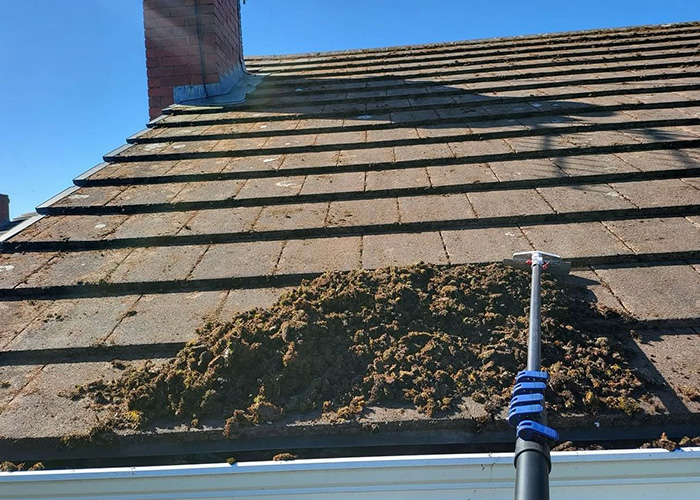
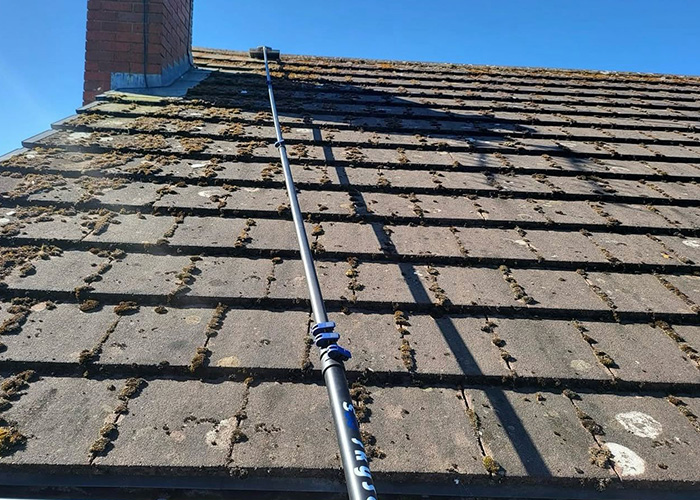 AfterBefore
Steep pitches, deep valleys and a lot of old slate
Most of what I clean around Church Stretton is not a modern estate roof. The older villas around the town run to steep pitches, deep valleys where two planes meet, dormers set into the slope and a good length of ornamental ridge. The stone cottages in All Stretton and Little Stretton sit lower but carry natural slate that has been up there a very long time, on mortar that does not want disturbing. The newer houses on the edges of town have concrete tiles, which are the toughest of the lot.
The tile decides how the job is done. Natural slate is thin and splits along the grain if anything leans on it. Old clay is porous, so the moss has texture to grip rather than a smooth face to sit on, and it holds harder than it looks. Ridge and hip mortar of a certain age is often the weakest thing on the whole roof, and it is the first thing careless work takes out. Concrete keeps its moss longest but puts up with the most. None of them get jet washed here. Every roof I touch is a low-pressure soft wash, and the full explanation of what high pressure does to a roof is on my Shrewsbury roof cleaning page.
One thing before you go outside and look. On nearly every property here the front elevation looks passable and the back is the problem, because the shaded pitch never properly dries out.
Why the green comes back, and how quickly
Church Stretton sits in a bowl below the Long Mynd, and the geography does most of the work. More rain falls here than out on the plain, the air holds its damp for longer, and the hills take the sun off whole pitches for hours at a time. On the Cardingmill Valley side of town, and up the lanes where mature trees overhang, some slopes barely dry between one wet week and the next.
Moss asks for three things: moisture, shelter from direct sun, and a surface with texture to grip. A shaded rear pitch under a tree gives it all three at once, and the spores arrive on the wind whether or not the roof was cleaned last year. That is the honest picture. Nothing anybody sells you stops spores landing on a roof.
What decides how fast the green returns is what gets left behind. Scraping or blasting the visible moss off takes away the cushion but leaves the fine root threads and the spores down in the pores of the tile, in the mortar joints and along the laps, ready to go the moment it rains. A roof done that way can look green again within a couple of seasons on this side of the hills, which is why people around here say roof cleaning never lasts. It is not that the cleaning failed. It is that only the top layer was ever removed.
What the biocide is doing after I have packed up
The soft wash lifts the bulk of it. The biocide deals with the rest, and it is the part of the job people underestimate, because there is nothing to stand and watch.
Once the growth is off, the treatment goes on and stays on. It is not rinsed away, since rinsing it off would defeat the point of applying it. It carries on working into the tile texture, the ridge joints and the shaded laps where regrowth actually starts, reaching what the clearing could not. Then the weather takes over, and every shower carries a little more of the dead growth and the black staining down the slope. That is why a soft-washed roof keeps improving for weeks after the day you pay for it, and why I would rather you judged mine a month later than while I am packing up.
What it does not do is seal the roof or stop new spores landing. It buys a long stretch where the surface is hostile to regrowth instead of ideal for it, and how long that stretch runs depends on your roof rather than on any promise I could make. An open pitch with sun on it holds well. A north-facing slope under trees on the hill side of town will come back sooner, and I would tell you that at the quote rather than afterwards.
Two things you control help more than anything else: cutting back branches that overhang the slope, and keeping the gutters clear so the bottom courses are not sitting in wet debris all winter.
How the job runs on a house up here
Roof work goes in the diary as its own visit rather than being squeezed onto the end of a round, and you get a text before I arrive.
Before anything is applied I cover the planting under the working area and check where the downpipes discharge, so what comes off the roof does not end up in a pond or a border. The clearing is worked in sections at low pressure, closer to a strong garden hose than a pressure washer, so nothing is blasted off the surface of the tile.
Wherever the roof and the ground allow it, I work from below with long-reach equipment. On slate and old clay that is not a preference, it is the only sensible way, because standing on them is how they break. Stretton properties can make that awkward: tight lanes, terraced frontages, banked gardens and plenty of roofs with nowhere flat to stand on the high side. If yours genuinely cannot be reached safely from the ground, I will tell you what access it needs and what that adds before you commit, not once I am halfway through.
At the end I check the gutters and downpipes for what has come down, and take a before and after photo so you can see the difference from ground level. You do not need to be in, which suits the holiday lets and second homes around here. I just need to know about locked side gates and dogs in the garden.
What moss removal costs up here
Roof soft washing starts at £250. What moves it up:
- The size and shape of the roof. Two modest slopes on a bungalow is a different job to a tall villa with valleys and dormers, and only the shaded rear often needs doing at all.
- How far the growth has got. A green film comes off quickly. A thick mat that has crept up under the laps and lifted them has to be worked out of the joints rather than washed off the face.
- Standing on a slope. Banked gardens and roofs with nowhere level on the high side change how the equipment has to be set up and moved.
- Getting to it. Tight lanes and terraced frontages decide where I can park and how far the reach has to travel.
- Tile type. Old slate and clay are worked slower and more carefully than concrete.
I confirm the price before I start and it does not move afterwards unless you ask me for something else while I am there. The one job worth adding is the gutters, from £55, because everything that comes off the roof ends up in them, and clearing it while it is loose costs a great deal less than dealing with a wall that has been soaked all winter.
Everything else I do, priced plainly:
- Window cleaning, from £18
- Fascias and soffits, from £60
- Conservatory roof, from £60
- Solar panels, £6 a panel
- Driveways and patios, £3.50 per m², plus £1.50 per m² to re-sand block paving
Church Stretton, the Strettons and the villages around
I am Jack. I have been cleaning exteriors across Shropshire on my own since 2011, working out of Shrewsbury, SY3 6AP, and the Strettons are a regular run for me rather than a special trip.
Alongside Church Stretton itself I cover All Stretton, Little Stretton, Minton, Hope Bowdler, Cardington and Wistanstow, including the properties up the lanes towards the Long Mynd and around Cardingmill Valley, where the shade is heaviest and the moss is always thickest.
Fully insured, domestic and commercial. There are 46 five-star reviews on Google at 5.0, and another 169 recommendations over on Facebook.
If you would rather have a figure than a conversation, the instant quote tool on this site will price the roof. If you would sooner talk it through, ring me on 07854 086820.
Other cleaning we do in Church Stretton
Roof cleaning in Church Stretton: your questions
Does moss actually harm a roof, or is it only how it looks?
It does more than sit there. A moss cushion holds water against the tile long after the rain has stopped, and in a hard Stretton frost that water freezes and expands in the surface and in the mortar joints. Growth also creeps up under the laps and lifts them slightly, and when clumps break away they wash down and pack the gutters and downpipes. Plenty of people book me for the look and get the rest as a side effect.
Is there a right time of year to have it done?
I clean roofs all year. Growth looks its worst coming out of winter, so spring is when most people ring, but the work itself is not seasonal. The things that move a date are hard frost and high wind, neither of which is rare up here, so I would rather shift a booking by a few days than work a roof in the wrong conditions.
Some of mine is flat black and orange rather than green cushions. Is that moss too?
That will be lichen. It clings flat to the surface instead of sitting on top of it, so there is nothing to lift off and it needs the treatment to do the work. It is dealt with on the same visit, but be aware it fades more slowly than moss disappears. Weeks of weather rather than an afternoon.
I have solar panels on the roof. Does that change anything?
It changes where I work rather than what gets done. Panels are cleaned from the ground with pure water and soft brushes at £6 a panel, and nobody should be climbing on them, because on some panels that can affect the warranty. Tell me they are there when you get the quote so the roof is worked around them properly.
My ridge mortar is crumbling and a couple of slates have slipped. Is cleaning still worth it?
Tell me before I quote. A soft wash does not pull sound roofing apart, but it will make an existing fault obvious, and I would rather point it out on the quote than have you find it after. If something wants a roofer, I will say so and leave that part alone. Repairs are not my trade and I am not going to pretend otherwise.
Roof cleaning in Church Stretton?
Get an instant guide price online, or call for a free no-obligation quote. Friendly, fully insured and proudly local.