Roof cleaning in Shrewsbury, soft washed from £250
I'm Jack, and I clean roofs across Shrewsbury on my own. Shade is what decides most of it: a north-facing pitch under mature trees greens up while the sunny side of the same house stays clear. I take the growth off at low pressure and treat what is left behind. Before any of that, I will tell you honestly whether your roof needs doing at all.
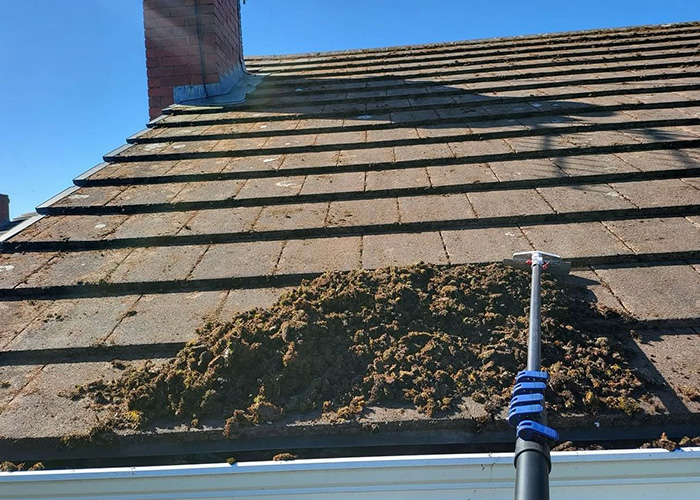
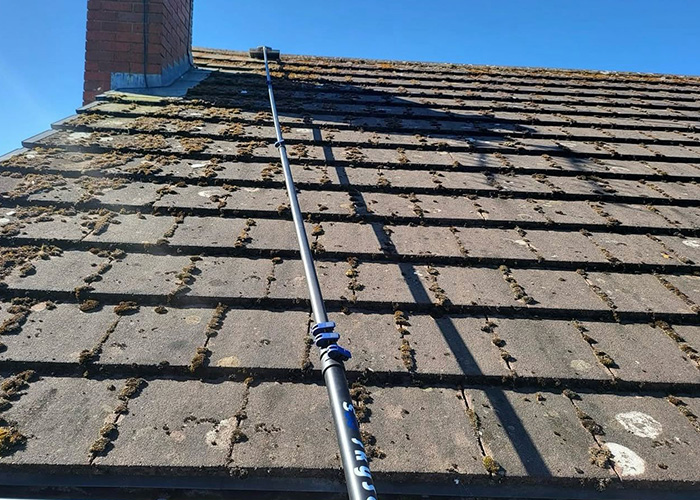 AfterBefore
Does your roof actually need cleaning?
Start with the question most people are really asking. Not every roof needs cleaning, and I would rather say so than take the work.
A light green tint on a slope that gets sun for most of the day is cosmetic. It is doing nothing to the tiles. Leave it a year and look again, and you have lost nothing but the year.
What is worth acting on is thick, spongy moss, the sort you could pull away in clumps. It sits on the tile like a wet sponge and holds water against it through every frost. It also breaks off in lumps, slides down the pitch and packs into outlets and valleys, which is how something on the roof quietly becomes a damp problem on a wall.
Signs worth a proper look: green fur along the bottom third of the slope, moss balls sitting in the gutter after a windy week, dark streaking running down one pitch only, or a roof that reads noticeably darker than the identical house next door.
Take two or three photos from the garden, as far back as you can get, and send them over. I will tell you whether it needs doing now, can wait until spring, or does not need doing at all.
Whether it is worth doing, and what it costs
Soft washing a roof starts at £250. That is a genuine starting figure, not a headline number with conditions hidden underneath it, and I am not going to invent a price for your house before I have seen it.
What actually moves that figure starts with the growth itself, because a thin film that lifts on the first pass and a deep moss mat rooted down into the surface are two completely different days of work. Tile type shifts it again, since concrete, clay and slate each want a slightly different approach, and the older clay and slate roofs carry far more detail to work around than a plain run of interlocking tile. The shape of the roof comes next: a simple front and back slope is one thing, a cut-up roof with several hips, valleys and dormers is another, and each addition means more edges to work by hand. Only then does raw size come into it, along with how steep the pitch is, because a steeper slope has to be worked more slowly to stay safe. The last thing I look at is what stands between me and the wall, so a narrow side passage, a conservatory sitting under the slope or deep planting tight against the house all feed into the final number.
The instant quote tool on this site gives you a guide figure in about a minute. I then confirm the real price from your photos or by calling in and looking, and you agree that figure before anything is booked. There are no extras added afterwards, and nothing starts until you have said yes to a number.
Concrete tile on the estates, clay and slate in town
Shrewsbury roofs split fairly neatly into two kinds, and they behave differently.
The newer estate housing at Bicton, Monkmoor, Bayston Hill and Sutton Farm is mostly concrete interlocking tile. The face of a concrete tile carries a granular surface, and that surface is slightly open, so moss grips it well and roots into it rather than sitting on top. Once a concrete roof has gone properly green it tends to stay that way, because the growth is holding moisture in the very layer that is supposed to shed it.
Nearer the middle of town, around Belle Vue, Town Walls and Copthorne, there is far more older clay and natural slate. Those shed water faster, but they carry a lot more detail: ridges, hips, valleys and mortar lines for growth to settle into.
Shade is the other half of it. Those older streets have mature trees standing close to the houses, so the roofs sit in shadow for much of the day and take a steady drip of leaf litter and sap. Organic debris on a tile is food, and growth follows food. Aspect finishes the job. On two identical semis at Radbrook or Meole Brace, the north-facing pitch will be furred years before the south-facing one, for no reason other than it never fully dries. That is why I look at your roof rather than pricing a roof shape from a map. Older stone-country roofs behave differently again, which is why the Church Stretton page approaches it from the other end.
Why I will not put a jet wash on a concrete tile
A pressure washer will strip a roof clean in an afternoon, and the photos look spectacular. Here is what it costs you.
The granular face on a concrete tile is the weathering surface. It is what makes the tile shed water instead of soaking it up. A high-pressure lance takes that layer off along with the moss, and once it is gone it does not come back. The tile drinks more, weathers faster in frost, and because a rough, porous face is exactly what moss wants, it greens up quicker than it did before it was cleaned. You pay to make the problem worse on a delay.
Pressure also drives water sideways and upwards under the laps, where tiles overlap and were never designed to hold water back against the flow. That water ends up on the felt, and on some roofs in the loft. On a brittle or already cracked tile, a close-range lance will finish it off outright.
Soft washing works the other way round. The chemistry does the work, not the force. The bulk of the growth comes away at low pressure, then a biocide goes on and is left to keep working, which slows the regrowth rather than resetting the clock to zero. It is less dramatic to watch and it leaves you with the roof you started with.
If a roofer or a cleaner tells you a jet wash is fine on tile, that is your answer about the rest of the job.
What happens when I come out
Everything is covered first: planting, garden furniture, the path, the drive, and wherever the runoff is going to end up. Anything that catches spray gets rinsed off before I leave.
The growth then comes away at low pressure, worked down the slope so the debris falls where I want it rather than packing into the valleys. Ridge lines and the detail around hips get worked by hand where that is the safer option.
Gutters come next, because a roof clean always finishes with moss in the guttering, and there is no sense cleaning a roof and leaving the mess sitting above your front door. If the gutters were already due anyway, say so at quote stage and I will do them at the end of the same visit rather than booking you in again, using the vacuum and camera setup. Each job is still priced on its own, it simply saves a second trip out.
The biocide goes on last. It carries on working after I have gone, so the roof keeps lightening over the following weeks. Do not judge the result on the afternoon you pay.
I take before and after photos on every roof as a matter of course, because you cannot see your own roof from the pavement and you are entitled to know what you bought.
Three questions to ask, and who you are calling
Ask these of anyone who quotes you, me included.
- What pressure do you use? If the answer involves a jet wash or a turbo nozzle on tiles, keep looking.
- Is a treatment included? A roof scrubbed clean with no biocide looks smart in October and is green again by spring.
- Is the price fixed before you start, and are you insured? Work at height with no cover behind it becomes your problem, not theirs.
TD Exterior Cleaning is run by Jack, working on his own across Shropshire since 2011, based in Shrewsbury, SY3 6AP. Fully insured, domestic and commercial. Google has me at 5.0 from 46 five-star reviews, and Facebook carries 169 recommendations. Use the instant quote tool on this site for a guide price, or call or text 07854 086820.
Other cleaning we do in Shrewsbury
Roof cleaning in Shrewsbury: your questions
When is the best time of year to have a roof cleaned?
Any time the weather allows, though autumn and spring tend to be the most useful. Autumn clears the moss before it spends the winter holding water against the tiles through the frosts, and it gets the debris out of the gutters ahead of the wet months. Spring works well if you want the treatment going on as growth is starting. The one thing I will not do is work a roof in a hard frost or a strong wind.
Should the gutters be cleared before or after the roof?
After, always. Cleaning a roof brings moss down into the guttering, so clearing it first just means paying for it twice. If your gutters are due as well, mention it when you ask for the roof price and I will do them at the end of the same visit, which saves a second trip out.
Is it worth cleaning the roof before selling the house?
It can be, because a green roof is the first thing a buyer notices from the pavement and some people read it as neglect whether or not it is. What I will not do is tell you it adds a figure to the sale price, because I have no way of knowing that. If the moss is thick it is worth doing on its own merits. If it is light staining on a sunny slope, spend the money elsewhere.
Do you have to walk on the tiles to clean the roof?
As little as possible, and on most houses not at all. The work is done from a ladder set at the eaves or on a pole from the ground, so the tiles carry no weight they were not meant to. Walking a roof is how tiles get cracked, particularly older clay and slate and anything gone brittle with age, so I stay off unless a section genuinely cannot be reached any other way. If that is the case on your roof, I will tell you before you book rather than afterwards.
Can you clean a roof that has solar panels on it?
Yes, and the panels are worked separately from the ground with pure water and soft brushes rather than treated as part of the roof. Biocide and panels are a combination I keep apart, because on some panels that can affect the warranty. Tell me the panels are there when you ask for a price so I can plan the order of work around them.
Roof cleaning in Shrewsbury?
Get an instant guide price online, or call for a free no-obligation quote. Friendly, fully insured and proudly local.